ACTIVE IMPLEMENTATIONS

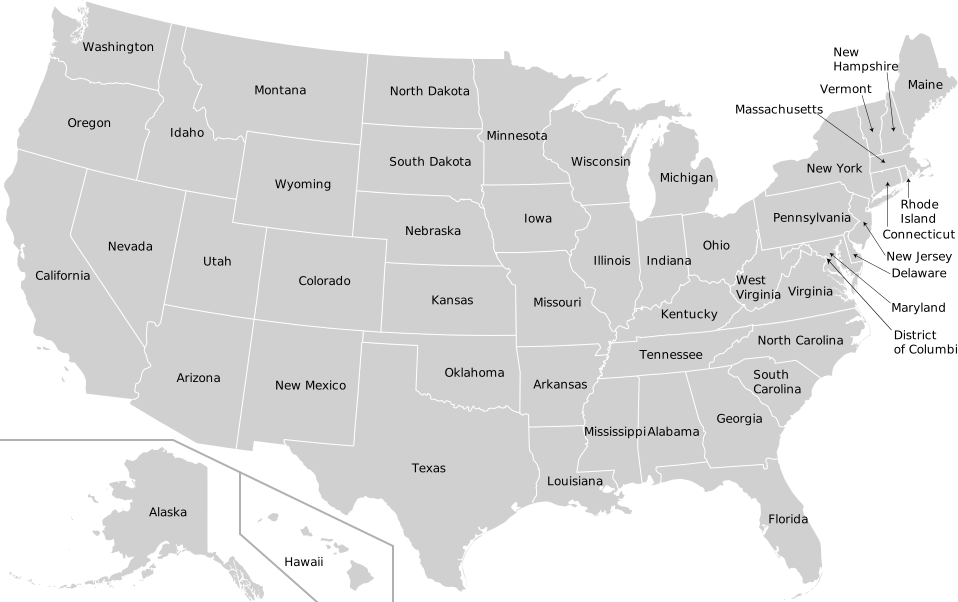
30 states

Urban, suburban, rural, charter, and private school contexts

See state approvals

RESEARCH FINDING

Largest predictor of student growth

Teacher observation score was the strongest predictor of student growth

Basileo & Toth, Practical Assessment, Research & Evaluation, 2019 · 12,000+ teachers · Florida

DATASETS

277,000+ classroom observations

The largest dataset linking observation scores to student growth on state assessments

Applied Research Center 2012-2018

THE FRAMEWORK

23 Competencies Across Four Domains of Expertise

The Focused Teacher Evaluation Model rubric gives observers a consistent, evidence-based standard across all 23 competencies—replacing subjective judgment with a shared language for growth. Each domain builds on the last — from how teachers plan, to how they teach, to the conditions they create for learning, to how they grow as professionals. Every competency has a specific desired effect tied to student evidence.

Standards-based planning

Standards-based instructions

Conditions for learning

Professional responsibilities

5-level performance scale

Not Using › Beginning › Developing › Applying › Innovating

91-100%

Student evidence threshold for "Innovating"— the highest scoring level

Competency-based

23 strategies with specific performance scales provide transparency and improvement insight

WHAT MAKES IT DIFFERENT

Focused Teacher Evaluation Model vs. Traditional Teacher Evaluation

Most evaluation systems were designed to document teacher performance. The Focused Teacher Evaluation Model was designed to change it. Here’s what that difference looks like in practice.

Traditional Model
  • Scripted observations measure what teachers do — not whether students are learning
  • 70+ elements create observer burden — averaging 13 hours per teacher per year
  • Simple score averaging penalizes teachers for growing — early low scores drag down year-end ratings
  • Vague feedback ("great lesson") gives teachers no clear path to improving their practice
  • Evaluation data sits in HR files — disconnected from PD planning or instructional decisions
Marzano Focused Teacher Evaluation Model
  • Student evidence is the primary measure — every element has a specific desired effect tied to observable student and teacher evidence
  • 23 focused competencies streamline observations — returning time to principals for coaching work that actually moves outcomes
  • Competency-based scoring uses multiple observations allowing teachers to refine their practice — rewarding growth rather than penalizing early developmental practices
  • Feedback is tied to a specific strategy, its desired effect, and a concrete set of techniques and ideas to improve — not just a score
  • Real-time data in iObservation connects observation scores allowing teachers and administrators to identify PD priorities, provide needed support and track professional growth

THE 5-STEP OBSERVATION PROCESS

The Focused Teacher Evaluation Model: Built for Accuracy, Not Just Compliance

The Focused Teacher Evaluation Model uses a structured 5-step observation process that moves observers from watching teacher actions to evaluating student evidence —ensuring every score is defensible and specific enough to drive meaningful feedback.

  • Identify which elements the teacher is using — does the teacher use the strategy correctly?
  • Identify how the teacher monitors for the desired effect — what technique is being used?
  • Determine what percent of students demonstrate achievement of the desired effect.
  • Does the teacher make adaptations when fewer than 91% of students show the desired effect?
  • Assign the final score using student evidence — confirmed in the post-observation conference in collaboration with the teacher.
Emily Freck

"I love using the Focused Teacher Evaluation Model because it gives me very specific examples of how I can help my students succeed in the classroom. It gives me measurable ways to check myself and to check my students and it gives me great strategies to utilize in the classroom to get my students where they need to be."

Emily Freck
Teacher, Brook Park Elementary, MSD of Lawrence Township, Indianapolis, IN

STATE APPROVALS

Teacher Evaluation Model: Active in 30 States

The Focused Teacher Evaluation Model is active in 30 states and maintains alignment to state evaluation requirements as a core function.

Ready to build an evaluation system your teachers will actually trust?

Talk to one of our specialists about your district’ts goals, timeline, and current system. No pitch decks. No pressure.

No obligation. Response within one business day

FREE DIAGNOSTIC

Is your teacher evaluation system driving growth — or just documenting it?

18 questions across 6 areas. Score yourself 1–4. Start the conversation with your leadership team.

COMMON QUESTIONS

Understanding the Focused Teacher Evaluation Model

Answers to how the model is scored, observed, and approved across states.

What is the Marzano Focused Teacher Evaluation Model?

The Marzano Focused Teacher Evaluation Model is a research-validated teacher evaluation system built around 23 high-leverage competencies across four domains: standards-based planning, standards-based instruction, conditions for learning, and professional responsibilities. Instead of documenting what a teacher did, the model ties every competency to a specific, observable effect on student learning. It was designed in partnership with Dr. Marzano and active in 30 states.

How many competencies are in the Focused Teacher Evaluation Model, and how are they organized?

The model includes 23 competencies organized into four domains. Domain 1 (standards-based planning) covers 3 elements. Domain 2 (standards-based instruction) covers 10 elements, including engaging students in cognitively complex tasks. Domain 3 (conditions for learning) covers 7 elements, including formative assessment, feedback, and high expectations. Domain 4 (professional responsibilities) covers 3 elements tied to policy adherence, content expertise, and collaboration.

How is teacher performance scored under the Marzano Focused Teacher Evaluation Model?

Teachers are scored on a 5-point scale (Not Using, Beginning, Developing, Applying, Innovating) using competency-based scoring. Rather than averaging scores across the year, the model uses a teacher's highest demonstrated score for each competency, so early-year development does not drag down a final rating. A student evidence threshold of 91 to 100 percent is required to reach the top level, Innovating.

What is the 5-step observation process?

The 5-step observation process moves an observer from watching teacher actions to evaluating student evidence. The steps are: identify which elements the teacher is using, identify how the teacher monitors for the desired effect, determine what percent of students demonstrate that effect, note whether the teacher adapts when fewer than 91 percent of students show it, and assign a final score confirmed in a post-observation conference.

Which states have approved the Marzano Focused Teacher Evaluation Model?

The model is active in 30 states across urban, suburban, rural, charter, and private school contexts. Examples include Colorado, aligned to SB 10-191 requirements; North Dakota, meeting NDDPI framework requirements; Minnesota, aligned to TDE evaluation requirements; and Florida, where the model is the FLDOE state model and the site of its peer-reviewed research validation.

How does the Focused Teacher Evaluation Model differ from traditional teacher evaluation?

Traditional evaluation systems typically use 60 or more elements, average scores in a way that can penalize growth, and rely on scripted observations that measure teacher actions rather than student learning. The Marzano Focused Teacher Evaluation Model uses 23 focused competencies tied directly to student evidence, scores on the highest demonstrated level rather than an average, and connects observation data to specific, actionable feedback and professional development planning.

Ready to build an evaluation system your teachers will actually trust?

Talk to one of our specialists about your district’s goals, timeline, and current system. No pitch decks. No pressure.

Schedule a Discovery Call

No obligation. Response within one business day

FREE DIAGNOSTIC

Is your teacher evaluation system driving growth — or just documenting it?

18 questions across 6 areas. Score yourself 1–4. Start the conversation with your leadership team.