By Lorah Neville, Executive Director, Marzano Evaluation Center
Originally presented at the MEC webinar, September 22, 2026.
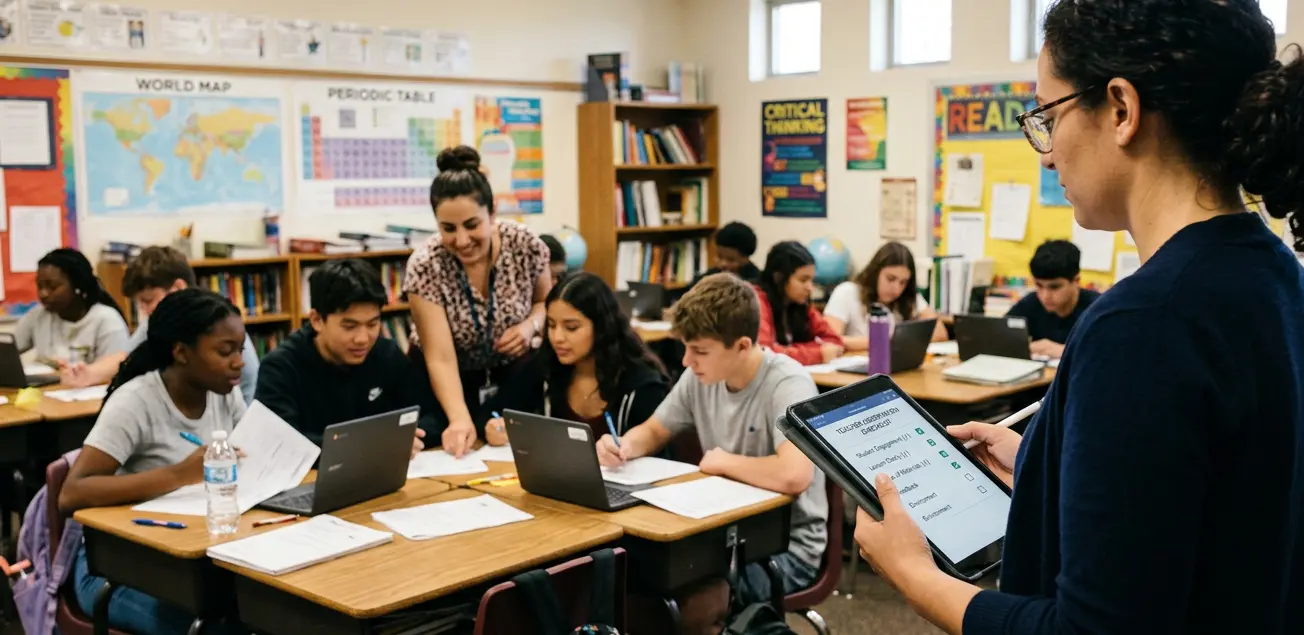
Early in my career, I was trained to script classroom observations. Every word, every move — usually about 11 single-spaced pages. Then I’d go back to my office and spend hours highlighting, sorting, and analyzing.
It took me a while to see the problem. I was doing all the analysis, and none of it was helping the teacher. I was spending my time on the wrong part of the equation.
I was spending my time on the wrong part of the equation.
Later, as a principal with 805 students, 70 staff members, and no assistant principal, I didn’t have hours to spend with a highlighter. I had to get efficient. In the process, I got more accurate, too.
Start With the Decision
The shift that changed my practice comes from an idea Dylan Wiliam calls decision-driven data collection (Wiliam et al., 2024). Instead of collecting everything and figuring out what it means later, you start with the decision you’ll have to make — a score, a piece of feedback — and collect the evidence that decision needs.
In an observation, that means putting on your framework lenses. Whether your district uses a Marzano model, Danielson, or a homegrown framework, you’ve adopted a set of competencies you expect teachers to perform well. That’s what you look through. You’re not writing a dissertation; you’re capturing what you saw and heard related to those competencies. Just the facts.
The five questions below are built on that idea. They apply to any framework, in formal and informal observations alike.
The Five Questions
1. What Am I “Seeing”?
Identify the strategy the teacher is using — or the one the moment calls for — and whether it’s being used correctly. In a formal observation, the pre-conference should tell you what to expect. In an informal one, I do two things as soon as I walk in: find the learning target and count the students. Both shape what I’m watching for.
“Correctly” comes from your own rubric’s description of the competency and its look-fors. If your tools don’t define what doing it correctly looks like, that’s worth fixing. Teachers need to know. At this stage, I’m not judging anything. I’m noting what I see and what I don’t.

2. How Does the Teacher Monitor Learning?
Think about a field trip. You take 35 students to the zoo, and you count them. Then you count again, and again. The longer you go between counts, the harder it is to find the student who wandered off toward the monkey house.
A lesson is a learning field trip. Everyone starts in one place, and everyone needs to end up at the target. Checking for understanding — whatever your district calls it — is how the teacher counts heads along the way. If you can’t see any monitoring, that’s evidence too, and it’s worth a conversation.

3. What Percent of Students Demonstrate Learning at the Target?
What the teacher does is necessary, but it isn’t sufficient. Just because it was taught doesn’t mean it was learned.
So count. Walk the room, listen to partner talk, look at what students are writing or drawing. Not “most kids” or “some kids” — how many? And count against the learning target, not the strategy. If the target is making and defending a claim, the evidence is students making and defending claims.
Numbers change the conversation. It’s hard to argue with 22 out of 27. That’s also why I coach observers to stop saying “I think” or “I believe” and start saying “I saw” and “I heard.”

4. Does the Teacher Adapt?
It’s rare that every student gets it the first time. Question 4 asks whether the teacher noticed who wasn’t with them and did something about it while students were still in the room. An exit ticket is valuable, but it tells you tomorrow. Adaptation happens now.
The best adaptations are planned ahead, even if they aren’t always needed. And here’s a question I ask myself: if no student needed any scaffolding at all, were they actually learning something new?

5. What’s the Final Score?
Only now do I score, using everything from Questions 1 through 4 plus any additional evidence the teacher can show me. Before I click that button, I ask: here’s what I saw, here’s what I heard — what do you have that I don’t?
That makes scoring a collaborative process rather than a verdict handed down. If I don’t have enough evidence, I keep asking. I won’t score something I can’t support.

What This Looks Like in a Classroom
A sixth-grade math teacher is introducing a process for solving multi-step equations. She models it, then has students practice with partners on whiteboards while she circulates. Nineteen of 30 students — about 63% — solve the first problem correctly without help.
She sees that, pulls a small group for a quick reteach while the others keep practicing, and checks again: 25 of 30, or 83%. Correct strategy, clear monitoring, a responsive adaptation, and a count that supports the score.
Now a contrast. A reading teacher models a graphic organizer for finding the main idea, checks in with 4 of 28 students during 15 minutes of independent practice, and moves on. All I know for certain is that four students — about 14% — reached the target.
That’s not a verdict; it’s a question for the post-conference. “I saw you check with four students. What about the rest?” When she shows me the completed organizers, 25 of 28 are correct. That changes the evidence, and it tells me exactly where to coach: how to check more students before making the next instructional decision. I’ll also ask about her thinking on not adjusting. As Stephen Covey put it, seek first to understand. There may be a reason I haven’t considered.
Three Mistakes Worth Avoiding
I can’t stop you from making mistakes, but I can help you skip the ones I made.
 Scoring too early.
I’ve walked into a room and made up my mind in the first five minutes. Once you do that, you spend the rest of the visit confirming your first impression instead of watching what’s actually happening.- Stopping at the adult behavior.
A teacher can ask 25 questions in a lesson. But if the strategy is meant to deepen students’ thinking and every question is simple recall, the strategy didn’t do its job. Always follow it through to students. - Accepting “most.”
“Most of the kids did well” isn’t evidence. What’s most? Put a number on it.


Where to Start
Calibrate, calibrate, calibrate. In every leadership role I’ve held, we pulled classroom videos and practiced scoring them together until we were all looking through the same lenses. Consistency and accuracy across observers is what makes evaluation fair to the people being evaluated — and it’s what makes the feedback worth acting on.
Take the Five Questions
Into Your Next Observation
with a pitfall check and a guide for calibrating as a team.
Wondering where your system stands?
Wondering how well your current evaluation system supports this kind of evidence-based observation?
References
Wiliam, D., Fisher, D., & Frey, N. (2024). Student assessment: Better evidence, better decisions, better learning. Corwin.
About the Author
Lorah Neville is the Executive Director of the Marzano Evaluation Center. She brings more than two decades of K–12 experience as a teacher, principal, director of curriculum, and superintendent. She works directly with district and school leaders nationwide to implement the Marzano evaluation models and build evaluation systems that connect to meaningful instructional improvement. She holds a degree in Elementary Education and a Master’s in Educational Leadership, and has served as adjunct faculty at Northern Arizona University and Arizona State University.